Sunday, May 31, 2020

Loquat tasting on May 30, 2020

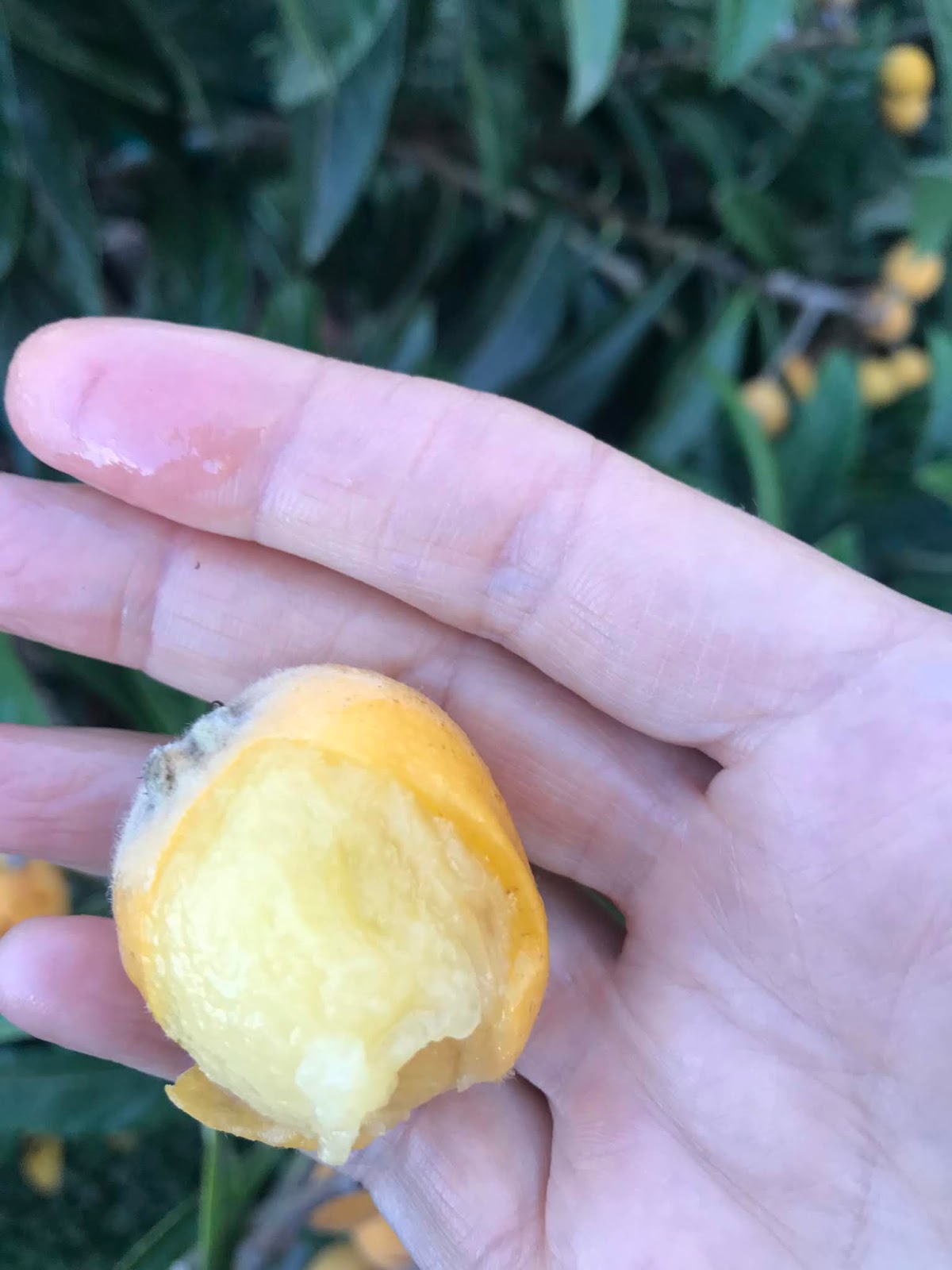
Describing here fruits of eight cultivars from three different locations. Argelino, Kando and Strawberry fruits are from my tree in Davis, CA. Fletcher White, Ed's Delight and Brandenton from a tree in Vacaville, and Haseeb and Frana came from a friend in Sacramento.

Frana, Ed's Delight, and Fletcher White are white loquats.  The other five fruits are orange.


Haseeb - Large fruits, soft, very juicy, sweet, no acidity, the flavor reminds the sweet soft summer apple with strawberry notes

Kando (Kanro) - Large fruits, firm, but still juicy, very sweet with low acidity, baked apple flavored

Bradenton - Normally larger fruits than the one in the picture, but all large fruits were too firm to pick.  The picked fruit is still not ripe, has some acidity, the flavor includes sweet under-ripe cherry

Frana - Medium size fruits, mildly sweet with no acidity, the flavor is mild and unusual, as it includes the distinct sugar pea and mild pear notes

Ed's Delight - Medium to large fruits, firm, sweet with little acidity, pear flavored

Fletcher White - Small fruits in large clusters, very juicy, very sweet with little acidity, bright pear-strawberry flavored. Below is a cluster of Fletcher White fruits. This year many fruits contained more than one seed.

Argelino (Angelino)- Large fruits, very juicy, a flavor bomb, as it contains high sugar and relatively high acidity, apricot-grape flavored

Strawberry - Medium size fruits, soft and juicy, sweet with little acidity, pear-strawberry flavored

My picks from this tasting are Argelino and Fletcher White


Plant material availability

None of these loquats are widely distributed. Argelino, Kando, Bradenton, and Ed's Delight trees are occasionally available from a few hobbyists, check the gardening forums and Facebook groups when looking for them. The scions are occasionally available at the CRFG exchanges. Currently, we are shipping the scions of Kando, Argelino, and Fletcher White, and we might have the trees later. Please check Really Good Plants for availability.


Saturday, May 23, 2020

Loquat tasting on May 23, 2020

All fruits were collected from my combination tree on the same day, May 23 of 2020 in Davis, CA.


McBeth and Gold Nugget are pretty sweet but simple and flat. Franceschi Park surprised me this year as it developed a good amount of sugar.  The flavor is very nice, with the honey notes, some acidity, and the fruit is very juicy. I only have a very small graft and should back it up.  It will never be overly popular as the amount of flesh is not very large, but I want preserve it. The best loquats here are Argelino and Kando.  They are quite different, and it its hard for me to place one over the other.  However, I found that some people do not detect/sense the sugars in Kando.

Here is the order of my preference:
1. Argelino
1. Kando
3. Franceschi Park
4. McBeth
5. Gold Nugget

Plant material availability

McBeth and Gold Nugget are available from La Verne nursery which supplies them to the large retailers. Argelino and Kando trees are occasionally available from a few hobbyists, check the gardening forums and Facebook groups when looking for them.  Currently, we are shipping the scions, and we might have the trees later. Please check Really Good Plants for availability.
The original tree of Franceschi Park loquat grows at the Franceschi Park in Santa Barbara, California. See the picture and location of the tree below.


Wednesday, April 29, 2020

Avocado cv. Long South Gate

It was about a year ago when CRFG were asked to check out a very old avocado tree in the Los Angeles area.  The tree produced unusually large and long fruits, and the owner was very excited about it.  As the Festival of Fruit was coming up in summer of 2019 the LA area, I decided to visit with the owner while attending the event. My friend Ray and I met with the owner Leonard B. in August, where we found three very large and old avocado trees.  The trees came with the house and Leonard didn't know much about them. Only one of them produces these enormous fruits. Leonard himself does not eat avocados, but his neighbors pick the fruit. He provided us with the pictures of the fruits, that are about 9 inches long.
The fruits ripen in fall and the leaves have anise smell, suggesting that this is a Mexican type avocado. Leonard graciously offered us to collect the wood and some unripe fruits. Ray and I grafted the scions onto our established trees. My grafts survived the winter fine and are growing pretty well now. I also made three new Long South Gate trees on Aravaipa and Duke seedlings. I am looking forward to evaluating this avocado in the conditions of Sacramento Valley.

An interesting detail about the location of these trees is that the Leonard's lot is a part of the original California land grants in the LA area. These trees look old enough for me to speculate that they may have been there before the land was divided into smaller lots. I'd like to extend my speculation by saying that they maybe a part of the early avocado introductions in California.

Check our sales site if we have the scions available reallygoodplants.com

Saturday, April 4, 2020

Early blooming apples

These are the five cultivars I found blooming on March 27, 2020.  They should be good pollinators for each other.

Pervenec Samarkanda

I received this accession couple of years ago from the USDA Geneva collection.  I am interested to see how this cultivar will perform here.  Our summers in Vacaville are similar to the hot summers in Samarkand, Uzbekistan. This is a very early ripening cultivar, and can be ready from end of June in Uzbekistan.

Pepin Litovskii

The cultivar has many other names, and thought to have originated in Eastern Europe. This apple ripens in Russia in September, but I suspect it should be earlier here in the CA Central Valley.  The fruits can be stored up to four months in fridge. This apple came to me as a cutting from the USDA Geneva collection.

Pepin Shafranyi

Excellent early dessert apple. A favorite in Russia. The cultivar was bred and selected by Michurin in 1907. The cuttings came to me from the USDA Geneva collection.

Brushy Mountain Limbertwig

The perennial favorite at the apple tastings held by the Monterey Bay Chapter of CRFG. I picked the scion at one of the CRFG winter exchanges in NorCal.

Hidden Rose

Also known as Airlie Redflesh. This is a pink fleshed apple originated in Oregon.  The cuttings show up at the CRFG exchanges. I obtained mine a few years ago from a fellow CRFG member.

Check our sales site if we have the scions available reallygoodplants.com

Saturday, March 28, 2020

Papaya seedlings make excellent fruit

Two years ago a friend sent me seeds from a Brazilian papaya fruit that she claimed was the best papaya she ever tried.  I started the seeds, gave away a bunch of seedlings, and killed a few in the open ground in Vacaville.  When outside, the seedlings melted with the first frosts in the fall of 2018. However, two seedlings got lucky as they were moved to my work greenhouse. They grew well over the last summer (2019) and started blooming in August.
While the first few flowers fell off, the plant started making the fruits right away. I had the first ripe fruit in mid-January, five and a half months after blooming.
Soon after I was able to compare the fruits from my two trees. While they both are excellent fruits and definitely the best papayas I ever tried, my favorite is #2.  This fruit has really complex flavor profile with refreshing citrus notes.

The trees are very vigorous and will need to go out of the greenhouse soon. I wonder if there is a way to propagate my seedling #2.

Some publications state that budding is doable in papya https://www.ishs.org/ishs-article/49_10

The seeds from clone #2 are available at reallygoodplants.com

Thursday, March 26, 2020

Loquat cv. Fletcher White

I have a relatively young tree of this cultivar that I purchased from Patrick Shafer in 2017. He sold it to me as Fletcher, but I only could find one mention of an old variety with this name. That mentioned cultivar should have reddish fruits.  I keep my tree under the "Fletcher White" name. I noticed that the last time Patrick was offering these trees, they were also under "Fletcher White".

Last year I took a few pictures of the tree and fruits, but never managed to put the info together before now.

The plant is growing in full sun in Vacaville, CA, and it produces very well. The bloom bellow is from December 20, 2018.
The fruit set in the image below is from May 17, 2019
The first fruit I tried the same day, May 17, 2019
The fruits are very flavorful and sweet when they are ripe.  Wait for the deep yellow color, that is their ripe stage. I'd say that this cultivar falls into the white loquat type, even as it's a bit yellowish. The pleasant surprise was to find out that this cultivar has one seed per fruit.  I found only one or two fruits that had two seeds in them.  All others were single seeded.

Another set of fruit pictures are from May 26, 2019.

To my knowledge, the only person who has trees of this cultivar for sale is Patrick Shafer in Philo, CA. His email is coolhybrids at yahoo. Right now (March 26, 2020) I have a small amount of scions for sale at ReallyGoodPlants.com

Tuesday, March 24, 2020

Cold hardy avocados for Sacramento Valley

Growing avocado trees in Central Valley could be challenging.  It is important to select adapted cultivars. I have personal experience with five avocado cultivars: Mexicola, Duke, Aravaipa, Royal-Wright, and Second Red. The latest two are my introductions from old (most likely seedlings) trees in Santa Rosa.

Mexicola

The tree is large and vigorous.  I planted my tree in 2001 on the northwest corner of my house. It started producing in 3-4 years after planting. The fruits are black, small, very flavorful, creamy and nutty with soft edible skin. It produces good crop every year between September and November. The trees of this cultivar are available at the retail nurseries.

Duke

This is an old Californian cultivar.  Was commercially grown before Haas.  The mother tree grows at the old Oroville Depot. Chaffin Family farm still produces them, and the fruits are occasionally available at the Chico market in October.  Bill Bird wrote about this cultivar back in 2012. The fruits are green, thin skinned, larger than Mexicola, not so complex in flavor, but creamy and smooth. This is a good cultivar to grow in Central Valley, because it's cold tolerant, maybe the most frost resistant cultivar that we have here. The seedlings of this cultivar make good rootstocks for our area. See how the Duke fruits compare with Mexicola in the picture below. Dukes are the green fruits on the left.

Aravaipa

This cultivar came from Arizona desert and said to tolerate the temperatures between 14F and 120F.
In my experience, it is a very fast and vigorous grower. The grafts and trees bloom in the second year after grafting, with good production in the third year.  The fruiting season is October and November. The fruits are green, larger than Mexicola, not so rich in flavor, but quite good for guacamole. I really like to use the seedlings of this cultivar as rootstocks; they germinate soon after planting, and grow fast. I guess they might be as good rootstocks as the Duke seedlings. In the below picture two Aravaipa fruits are on the right. The black ones are Mexicola.

The cut fruits of Aravaipa (upper left), Mexicola (upper right), and Duke (bottom) in the image below.


Second Red

The original tree of this cultivar grows in Santa Rosa, CA on Second street.  The fruits are red, hence the name. I collected the scions in 2016, and made the first trees then.  This cultivar seems to be the most cold sensitive from the ones described here. Nevertheless, the tree made it fine after 3 years in ground.  It was planted in 2016, and at the time it was a few months old newly grafted tree.  The temperature range it has experienced was from 23F to 108F.  Now, after the third winter in ground, the tree has no damage at all. In the first and second winters, the upper growth was affected. I didn't use any frost protective measures. The tree is about 6 feet wide and tall now, and it didn't fruit yet.  The fruit I tried from the tree in Santa Rosa was excellent. The fruits are large, dark red and glossy. The flavor is nutty and complex. The texture is smooth and oily. They are ready in February - March. See the fruit in the picture below. I'm looking forward to tasting my own fruits from this tree.


Second Red avocado tree is also very ornamental in spring when it produces deep red new leaves, see the picture below.

Royal-Wright

The original mature tree grows in a private yard in Santa Rosa, CA. I collected the material in 2016 and started grafting. Two small grafted trees were planted in Vacaville in summer of 2016. This is a frost tolerant (23F with slight damage of young tree, no damage last winter), fast growing, precocious, spring producing avocado. I harvested the first fruits from one of my trees this year.  As this is the spring ripening avocado, the fruits should be on the tree for about a year. The fruiting season is March to May. The tree blooms in April and May. The fruits are large, green, creamy and nutty in flavor. See the fruit size in the picture below. 

The new growth on this avocado is also very ornamental in spring.  The new shoots and leaves are deep brown-red. The picture below shows the tree color in May (left) vs March (right).


The last four varieties are not available as trees in commercial nurseries, with the exception of Aravaipa, that is available occasionally at https://www.greenlifebyshamusoleary.com/ in Arizona.

I distributed the scions from all these trees through the Sacramento CRFG grafting meetings and green wood exchanges. Occasionally, I sell the scionwood at ReallyGoodPlants.com


BRIX and pH Values for Various Yangmei Cultivars

  I measured the BRIX and pH values for 9 different selection of yangmei on June 15, and for 5 selections on June 24. Whenever possible, 3 f...