Tuesday, November 3, 2020

Cupuaçu, my first time tasting the fruit

I was quite excited yesterday when I found my first ever cupuacu delivered from Puerto Rico. It was too late to try it yesterday, so we tasted it today, on November 3, 2020. Thank you Bryan Brunner from Montoso Gardens in Puerto Rico.

The package smelled like a fresh acrylic paint, and my husband thought that I got a spray paint and it exploded inside. The smell was actually not that strong. It could be that the cardboard box just accumulated a lot of it while in the transit. The fruit is large, brown, and velvety with a hard shell. Here it is next to my head.

To open the fruit I dropped it a few times onto the concrete patio. When the shell is cracked it is easy to open the fruit by the removing the shell pieces simply by hands. The inside smell is different, and more fruity but still with a lot of aromas we used to associate with artificial flavorings. Some kind of a mix of pineapple, passion fruit, jack fruit, etc. 
The fruit consists of multiple large segments each containing one large seed.  There are couple of videos posted by fruit geeks stating that the fruit is very sour.  So I was careful when putting the first segment into my mouth.  Maybe I'm more used to sour fruit, but I didn't find it especially sour.  The sourness is mostly present on the fibers' ends that are close to the seeds. 
For the rest of the segments I cut off the flesh with scissors, and collected it into a bowl.  I probably consumed a good quarter of the fruit in the process.

The flesh has incredibly powerful flavors and aromas.  Like every strong flavored fruit you had, all mixed into one. I could taste pineapple, guava, jackfruit, passionfruit... Now combine this with the texture of salmon sashimi! While I'm typing this, my hands still smell chocolaty passionfruit. In this fruit I found 26 segments with seeds. The middle core consisted of hard fibers covered with the most sweet and soft flesh.

I consumed that middle flesh happily, and this revealed the hard fibers that were holding it.
My husband found the fruit very good, interesting and complex, and his first impression was that I gave him a Russian style salted salmon.  Apparently the texture is more important for him that the actual flavors.  He got all of them later too, and says that there are many of them in this fruit.  The fruit was too overwhelming for my son, who is a kind of a purist.  He didn't appreciate that many flavor in one fruit on top of the unexpected texture. More goes to me! I'm going to experiment with the remaining pulp and mix it with dates and water.

Saturday, October 31, 2020

American Persimmons. Meader, Early Jewel, and Lehman's Delight

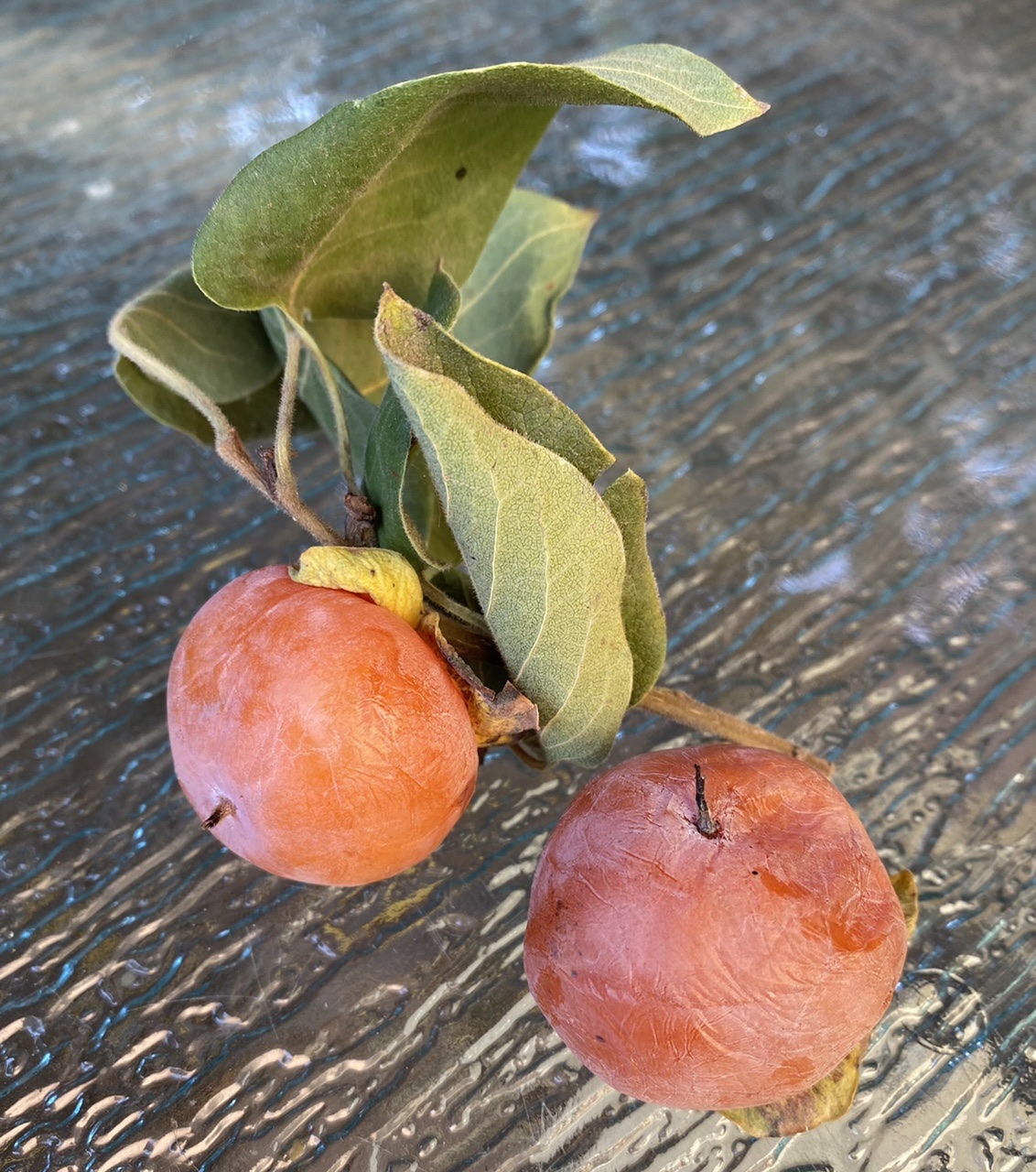
I have a 5 years old tree of American persimmon (Diospyros virginiana) selection H-63A. The original tree hardly makes any fruits.  I grow it in Vacaville, California Central Valley. The tree makes a lot of young fruits that all dropped with the first heat waves.  However, a number of recent grafts of other cultivars on it started fruiting.  Dressing the fruits into bags allowed me to get the fruits to taste this year. Last year, the birds took them all. Now the fruits are dropping into the bags when perfectly ripe.  They were collected and tasted on October 31, 2020.


Meader is a well known cultivar. Makes small fruits with dense texture, very sweet, has the expected strong butterscotch/rum flavor.  Excellent fruit. 

Early Jewel  is also known as H-118, and Prairie Star (R) at One Green World nursery . It is one of the selections that came from the late James Claypool breeding program. The fruits are significantly larger than Meader, but less dense in texture. It is also less sweet than Meader, and has a well pronounced butterscotch/rum flavor. Overall it is a very good fruit, but less intense in sugar and flavor than Meader.

The trees of both cultivars are available from England's nursery and One Green World nursery

Update from a follow up tasting on November 8, 2020

Last Sunday I collected four more fruits from my combination tree, a 100-46 fruit, two fruits of Early Jewel, and a fruit of Meader. They are in this order from left to right in the picture below.


100-46 is the largest fruit and it is excellent in the flavor and texture. It has everything you expect from American persimmon on top of it's large size. This cultivar is also known as Lehman's Delight. and available from England's nursery.

I found the fruit of Early Jewel to be much better flavored this time than the one in my previous tasting a week ago. The Meader fruit I got this time was past it's prime stage. I should have more of these later.


Update from a follow up tasting on Saturday November 14, 2020

I collected three more fruits, one from each cultivar, 100-46 (Lehman's Delight), Early Jewel (H-118), and Meader. They are in this order from left to right. 

Lehman's Delight and Early Jewel were excellent fruits here. This Meader fruit was under ripe.


Update on September 26, 2021

I found a few ripe fruits of H-63A, this is the original tree that I used to graft on additional cultivars. The tree is pretty large but the production is low as the tree drops most of the fruit in the fist heat waves usually in May-June. The fruits I got to taste are excellent with no astringency but very strong sweet butterscotch flavor.


D-128 graft (Dollywood) also produced one very sweet large fruit with the strong flavor.


Unfortunately, the branch of 100-46 broke off this summer.  It was overloaded with fruits and I should have thinned them. I will need to graft it again.  

Check our sales site if we have the cuttings available reallygoodplants.com


Tuesday, October 27, 2020

Feijoa tasting in late October of 2020

The summer of 2020 was unusually hot allover California.  In the Central Valley, we experienced five heat waves with the temperatures over 100F. This was not an ideal season for the development of feijoa fruit.  I do not expect to have many fruits of good quality this fall.  But it seems, that some cultivars more heat tolerant than others.  In September, I had a good crop of Kaiteri with excellent large fruits. Kaiteri is my earliest cultivar, and it was done fruiting by the end of September. Below are the fruit pictures.

By the end of October I noticed fallen fruits under some trees.  They could be ripe, or they just fell prematurely. Here are the results from this round of tasting on October 26, 2020. I suspect that the fruit quality was affected by the unusually hot summer weather.

Chesterwoody - Sweet, little acid, pleasant, gritty, no jelly but relatively creamy and smooth, very good overall.

Marta 8 - One of my seedings.  Sweet, crunchy, no jelly, unusual, some bitterness maybe coming from seeds. I need to try more fruits.  These were not good.

Flavia - Sweet with significant acid, gritty, jelly is developed, good overall.

8 Ball - Sweet, low acid, firm, jelly developed, gritty, good overall.

Moore - Very sweet, very low acid, no jelly, good overall.

Albert's Pride - Low sugar, low acid, no jelly, crunchy, low grit, but just OK now.

Marion (the fruits turned out to be from rootstock under Marion) - Low sugar, low acid, some jelly, no grit, just OK now.

Triumph - Good sugar content, very little acid, smooth, no grit, very good.

Marta 11 - One of my seedlings. Good sugar and acid balance, good jelly development, no grit, maybe good, but I need to try more than 2 fruits.


Check our sales site if we have the cuttings available reallygoodplants.com


Wednesday, October 14, 2020

Four Seasons Mulberry, or Taiwanese Four Seasons Mulberry

Four Seasons mulberry is a unique cultivar that is able to produce fruits from May and into December in Sacramento Valley.  I suspect it is evergreen and producing year around in the tropical conditions. The first wave of fruits is never as sweet as the fruits from July and later in the season. They are sweet and complex when ripening in hot weather. They also have some pleasant acidity. The fruits are large and black.  The tree is small, and it grows like a bush, branching low at the base. The branches are slender and the leaves are small.

Two photos below are from May

The next picture below is from August

September fruits in two pictures below


November fruits on the branch below


And the last picture shows how the fruits of this cultivar compare in the size and shape with othe mulberry cultivars.  This picture is from June.

When I have the propagation material available, I list it at reallygoodplants.com


Monday, September 7, 2020

Oak leaf papaya, Vasconcellea quercifolia


In the fall of 2016 I adopted four tiny seedlings of oak leaf papaya. They were started by Brian, a fellow gardener from the Golden Gate chapter of CRFG. The tiny plants spent their first winter indoors, and I planted them outside in the spring of 2017 but the Southern wall of a building in Vacaville.  They took off right away, and three of them already bloomed by the end of their first season. I planted them in bottomless one gallon pots for a better drainage when young.

The first season in ground, summer of 2017

Male flowers

Female flowers

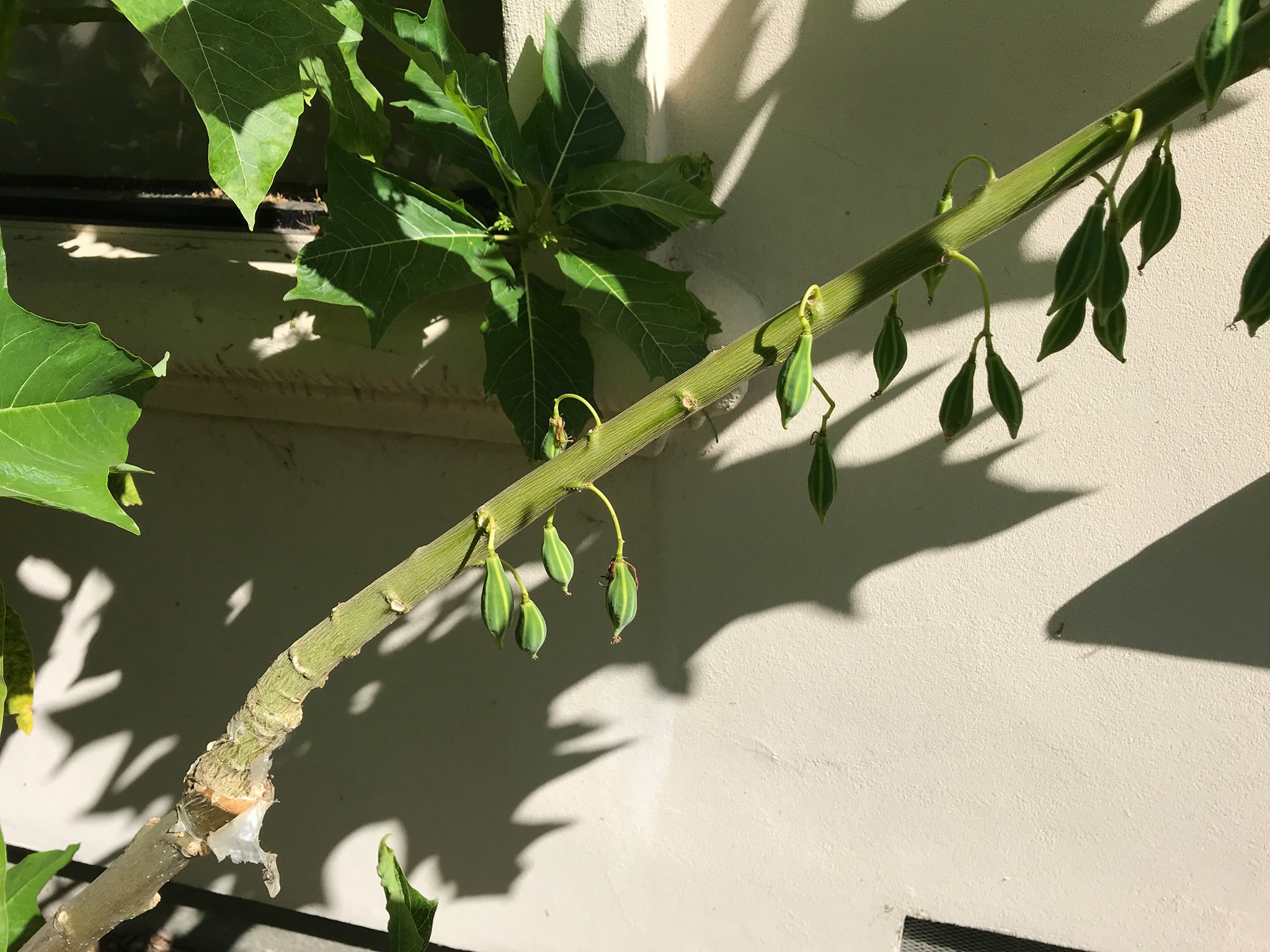
By the end of 2017 I already harvested the very first fruits from my only female plant.  The other three turned out to be males. The first winter in ground was a real test if they are going to make it here. The plants lost the foliage right with the first frosts, but the stems were not affected by the frosts down to 23F.   Here is how they looked on December 14, 2017


They budded up just fine in the following spring. The picture below is from February 15, 2018.

In the summer of 2018 I got the first real crop of sweet fruity papaya berries.  If you don't bite into the seeds, they are sweet. If you do bite into the seeds, you'll get the spicy flavor too.  They can be used in salads or simply eaten off the hand. 
August 31, 2018 


In the spring of 2019 I grafted a scion from the female plant onto one of the males, and it took fine. Here is a picture from May 9, 2019.


The female branch started fruiting right away. I need to do more of these grafts. The graft joint (in the lower left corner) and immature fruits on the female graft on August 25, 2019

Now, in the summer of 2020 the plants are very tall, with some are standing over the building roof, with the trunks of at least 5-6 inches, and the females produce plenty of berries in late summer.

This species deserves a better placement in the zone 9B gardens.  My plants tolerated well the temperatures between 23F and 110F. As the species is dioecious, a few seedlings should be grown to make sure that both sexes are present. 

When I have the seeds available , I post them at reallygoodplants.com

Sunday, September 6, 2020

Tomato selection by my family, cv. Optimal

Back in 2012, I was regularly buying (U-picking) tomatoes from Brad Gates at his stand and fields in Solano county. He also had a field with F2 progenies from his crosses, and he allowed me to pick some tomatoes from there too.  After tasting the fruits from the F2 field together with my friend Harvey, I ended up with few fruits that I wanted to stabilize. Over the next 8 years, every summer my family chose the best tasting fruits/plants from each hybrid line. Every year I planted 12 progenies from the best tasting plant of the previous year.  In 2019 we ended up selecting just one stable cultivar out of the three hybrid lines we started from.  Presented here is Optimal: a beautiful, productive, and tasty tomato. It is sweeter than Pink Berkeley Tie-Dye, but has about the same amount of salt. It has less acid than Pork Chop, but still some acidity is present, and it has its own flavors that are not present in either Pork Chop and Pink Berkeley Tie-Dye.  It does not have any smoky flavor that can be tasted in many darker and some green tomatoes from Brad Gates.  It is a beautiful yellow-red tomato that is best tasting when it becomes more red than yellow.

 Here is the final selection, the fruits are from 2020


Some tasting plates from 2018

Collected fruits and one of the plants from 2016

For anyone who wants to try growing this tomato cultivar, I will make the seeds available for purchase at reallygoodplants.com

Thursday, August 6, 2020

Growing yangmei seedlings, early observations

The germination may take a year or more, and it does not seem that the germination media is that important.  Most of my seedlings germinated in a potting mix, and I also found one beautifully developing seedling in the clay soil of my side yard. The cold moist storage or overwintering outside in a cold winter weather (30-45F) seems to be important.


The germination success was about 20% for three different batches of seeds I had.  About 1/3-1/2 of seedlings died early. Additional seedling loss happened after the excessive fertilization, transplanting, and over-watering.

When transplanting to individual pots, I use commercial potting mix with additional perlite and sand. I still do not know what is a good fertilization regimen for the seedlings. Iron with manganese (1/2 of recommended dilution) seems to be beneficial. Monopotassium phosphate is very dangerous, it kills the seedlings fast. I am not yet sure if nitrogen and potassium help or harm.

Yangmei seedlings also seem to be pretty sensitive to the pests and pathogens. Keeping them under mature trees invites all the possible pests and pathogens that fall from those trees down onto the seedlings.  Large trees harbor many small and large pests without being much affected by them. However, when those fall down onto the young yangmei seedlings, they decimate them fast. If you have issues with the leaf discoloration, it could be the pests. Get a magnifying glass and check if you see any mites or thrips on the back side of the leaves.  They can be easily washed away with water. I didn't test any pesticides on the yangmei seedlings yet, but I sprayed some with Serenade, a bio-fungicide.  It seems that they react well to Serenade. Keeping the seedlings under a shade structure or a shade sail would be safer than under large trees. The shade structure will limit the amount of pests, pathogens, and dust that fall down onto the plants.

In summer of 2021, yangmei seedlings are available from https://www.wildlandsplants.com/shop/p/myrica-rubra


BRIX and pH Values for Various Yangmei Cultivars

  I measured the BRIX and pH values for 9 different selection of yangmei on June 15, and for 5 selections on June 24. Whenever possible, 3 f...