Showing posts sorted by date for query black prince. Sort by relevance Show all posts

Saturday, December 9, 2023

Mulberries in 2023

 The spring and summer of 2023 were very busy for us as we planted over a thousand trees during this time. Only occasionally I took the videos and pictures of the fruits. The mulberries fruited great and we enjoyed them very much.

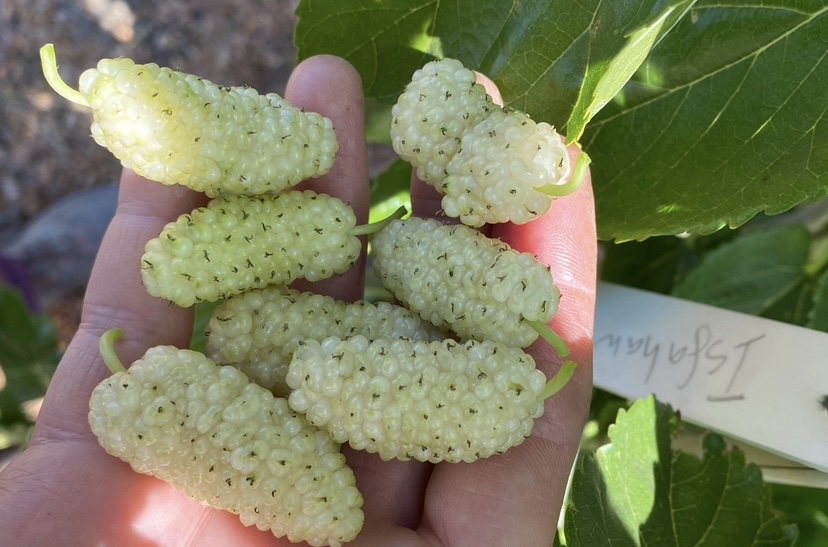
In the image below starting from top clockwise: DMOR9, Australian Green, Black Prince, Easter Egg. Isfahan is in the middle.

All these are great mulberries with unique flavors. 

Australian Green is honey sweet without any acidity. It’s probably identical to Saharanpur Local and Pakistan White.

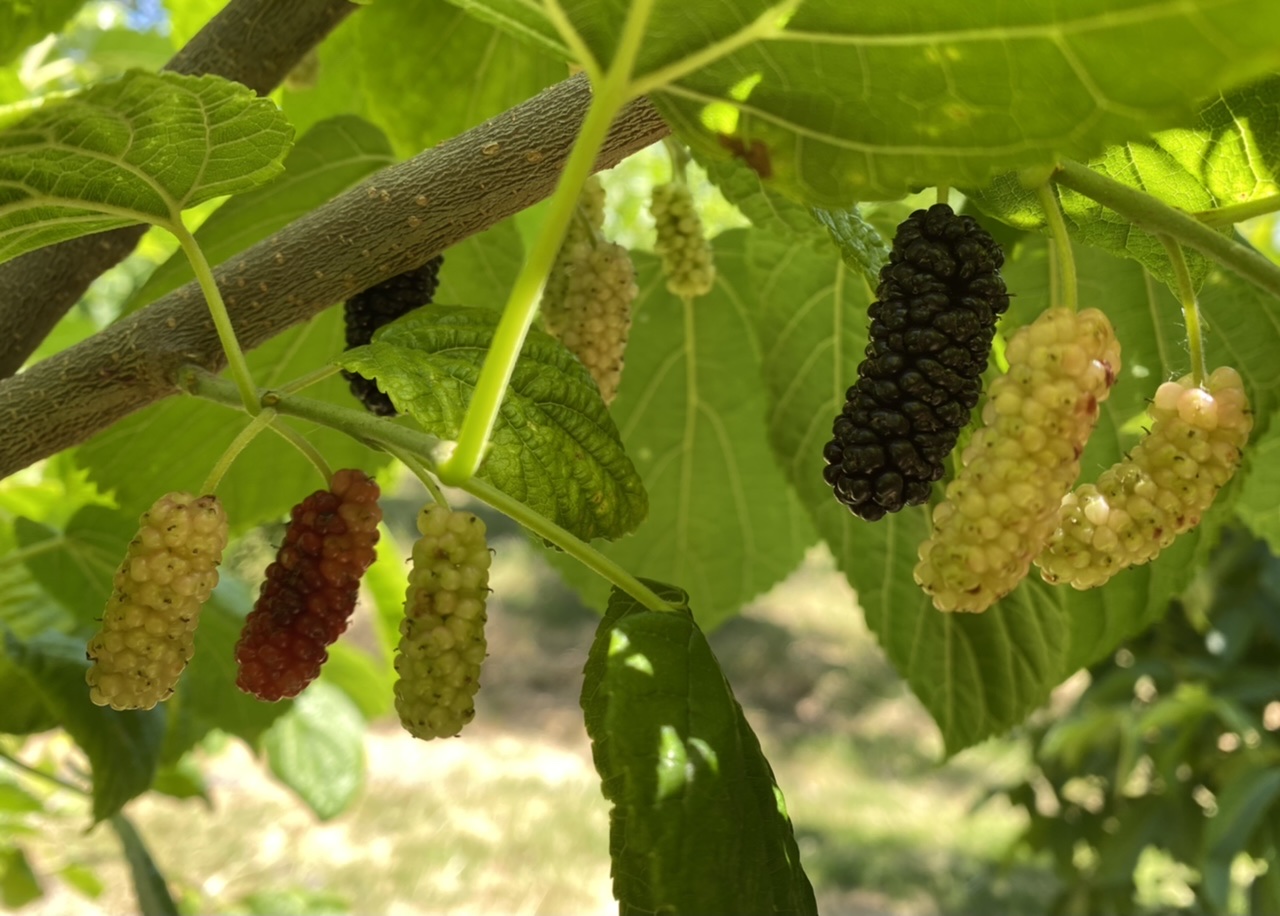
Black Prince is a very productive intense flavored berry fruiting later the most. It’s very sweet with some acidity. Highly frost tolerant, originally from Ukraine. The berries also have a better storage life than other mulberries. I planted multiple trees of this cultivar as I think it has a commercial potential for local fruit sales. Below are a couple more pictures of Black Prince from June.

Black Prince will also fruit in a pot at least for a couple years, but you would need to prune it hard as it’s a large tree normally. Below are the fruit on my potted tree before I put the plant into the ground.


Easter Egg is purely sweet but with a floral flavor in them. Great mulberry.

DMOR9 is one of the best flavored long fruited mulberries. Seems to be perfectly frost tolerant in zone 9B.

Below is DMOR9 on the right and Taiwanese Long on the left. These are very similar but have a little different flavors. Taiwanese Long tree is more frost sensitive and the upper canopy was damaged by the frost to about 4 feet from the ground.
Taiwanese Long leaves also have very different form than DMOR9. Here is the berry on a leaf.


Isfahan is very large and fat pure sweet white mulberry. The tree is large and produces abundantly.

Frank is also pure sweet mulberry tinted with lavender.

Shangri La makes large black sweet-sour berries that need to ripen completely to be enjoyable. Some consider this as one of the best flavored mulberries. Very large leaves.

Aussie is a very early wonderful mulberry with extra large berries which are often of irregular form.

Galicia is another mulberry from Ukraine with a great degree of frost tolerance. The berries are large, black, sweet, but relatively mild in the flavor.

My plan for the next spring-summer is to record every mulberry which I still don’t have presented on my blog here or on my YouTube channel. Make sure to check the mulberry videos I have there: https://www.youtube.com/@reallygoodplants/search?query=mulberry

The cuttings of the above described accessions and a number of others are usually available during the sales at reallygoodplants.com

Friday, June 18, 2021

Mulberries in June of 2021

 Buluklu is the queen of the June show. Pakistan White still produces a good amount of fruit. Himalayan DMOR9 is mostly done, this was my earliest mulberry.

Buluklu in the below image. Very sweet melting berries.

Buluklu, Pakistan White, and the last smallish berries of Himalayan DMOR9 by the end of the month.

Early in the month I had good sized DMOR9 fruits, image below


Black Prince is fruiting on my young trees and grafts, three pictures below 
Plenty of Pakistan fruits

Maple leaf is still a good producer this month, 2 images below 
Still plenty of Oscar fruits. 
Four Seasons mulberry fruits are sweet and flavorful by the mid June, see them in the image below.
And the Persian Morus nigra LA just starting to get ripe 

There are a few black fruits on my Morus nigra Kaester too.

Plants or scions for some of these cultivars are occasionally available at reallygoodplants.com

Tuesday, May 25, 2021

Mulberries in May of 2021

This year we started picking mulberries already in April. The first cultivar to produce was Himalayan DMOR9, the longest berry in the picture below. Here I have (left to right): Pakistan, Oscar, Maple Leaf, Himalayan DMOR9, Pakistan White, Big leaf FL


Himalayan DMOR9 is an excellent mulberry with very high sugar and some acid, a few more pictures below 


The tree is large and vigorous. The cuttings do not root and the propagation is by grafting mostly. I didn’t try the air layering yet, this might work too. The leaves are slightly lobed.


Pakistan  White (Saharanpur Local, Australian Green) produces extremely sweet long white mulberries. No acid in these fruits and they can be consumed even when not fully ripe. The tree is very vigorous. The cuttings do not root and should be grafted.


Oscar is a relatively common cultivar with sweet- sour fruits. They need to be fully ripe to be enjoyable. Just a standard good dark fruit without anything special in it. Large tree that needs pruning every season.  Oscar dormant cuttings can be rooted. Below are the Oscar fruits along  a few Pakistan white fruits.
In two images below I show how Oscar compares to Maple Leaf mulberry fruits. Oscar is on the left in both images.
Maple Leaf is an excellent mulberry and deserves a better distribution. The fruits are long, some can be as long as the smaller Pakistan mulberries. Very sweet with a little acid. The tree is large. It seems it can be rooted from dormant cuttings. The images are above along with Oscar fruits. In the below image, Maple Leaf is the rightmost fruit. Left to right here are Himalayan DMOR9, Pakistan, Oscar, and Maple Leaf.

Buluklu mulberry just started ripening in the end of May. The large tree produces a lot of sweet very juicy fruit without any acidity. I like them very much. This type of the fruit is very common in Central Asia and Turkey.
In the image below, all short white fruits are Buluklu.

Big Leaf FL
is the code name for the mulberry that came nameless from Florida. The fruits are relatively large, black, sweet-sour and need to be completely ripe to be enjoyable. The leaves are very large on this tree. In the image above, these fruits are on top of the Buluklu fruits in the container on the right.
More pictures below.


Pakistan
 is a very good large fruit with a balance of sweet and sour, more on the sweet side. It’s not as intense as the Himalayan DMOR9 however. Here is how it compares to Illinois Everbearing in the picture below. This is a large tree, needs yearly pruning. The dormant cuttings can be rooted.


Illinois Everbearing
is just starting to ripen the very first fruits. It’s a later ripening cultivar. The fruits are small, sweet-sour and need to be fully ripe to be enjoyable. The fruits are in the picture above on the right. The tree is large, the cuttings do not root and should be grafted.

Black Prince doesn’t normally fruit in May, but I have a grafted tree in a 10 gallon pot by the Southern wall in my backyard and it produces now. The fruits on my in ground tree are not ready yet. These are excellent, very sweet with a little acid. The fruit size from this potted tree is smaller than the ones from the in ground tree. 

The fruits have a lighter middle core.

I should move this tree to a large pot of I want to keep it in my yard. Here is the tree:

Black Prince trees are large, and it seems that the cuttings can be rooted.

Material availability.  Many of these can be found as cuttings at the winter exchanges organized by the CRFG chapters.  If I have material for sale, I post it at reallygoodplants.com 


Monday, June 22, 2020

Mulberry cv. Black Prince

The tree is large, with the fruits ripening mid to late June in Sacramento Valley. The fruits are up to 2 inches long, fat, very dark with the lighter middle core. They are sweet with some acid, and nicely flavored. The fruit holds well for a mulberry and may have a good shelf life (when I get enough to keep them on a shelf).

The cultivar should be frost resistant, but this needs to be evaluated better in the US.  It grows as far North as Lithuania and Southern Finland.


I am planning to make this accession more available in the US. Occasionally we have small trees available for purchase at reallygoodplants.com


BRIX and pH Values for Various Yangmei Cultivars

  I measured the BRIX and pH values for 9 different selection of yangmei on June 15, and for 5 selections on June 24. Whenever possible, 3 f...