Saturday, July 29, 2023

Second set of summer apples

 This post describes four apple cultivars ripened by the end of July 2023. These were grown in a Sacramento Valley orchard. Below left to right: Mislabeled (probably Ginger Gold), Pepin Shafranyi, Red Alla (probably a strain of Gravenstein), and Amy’s Pink Flesh.


Amy’s Pink Flesh 


Soft, mushy, low acid, low sugar with some bitterness. Overripe by now, but was better tasting a week ago. Below is a picture of Amy’s Pink Flesh on July 21, 2023.


Red Alla


This might be a strain of Gravenstein. The fruit stem is very short, the flowers fit the Gravenstein type, see the flowers pictured below. I do not have a Gravenstein fruiting tree to compare directly. 

Soft but structured flesh with good balance of sweetness and acidity. Enjoyable to eat. Can form glassy patches, see the picture below. For the summer apples, I don’t consider the glassy patches to be a defect.
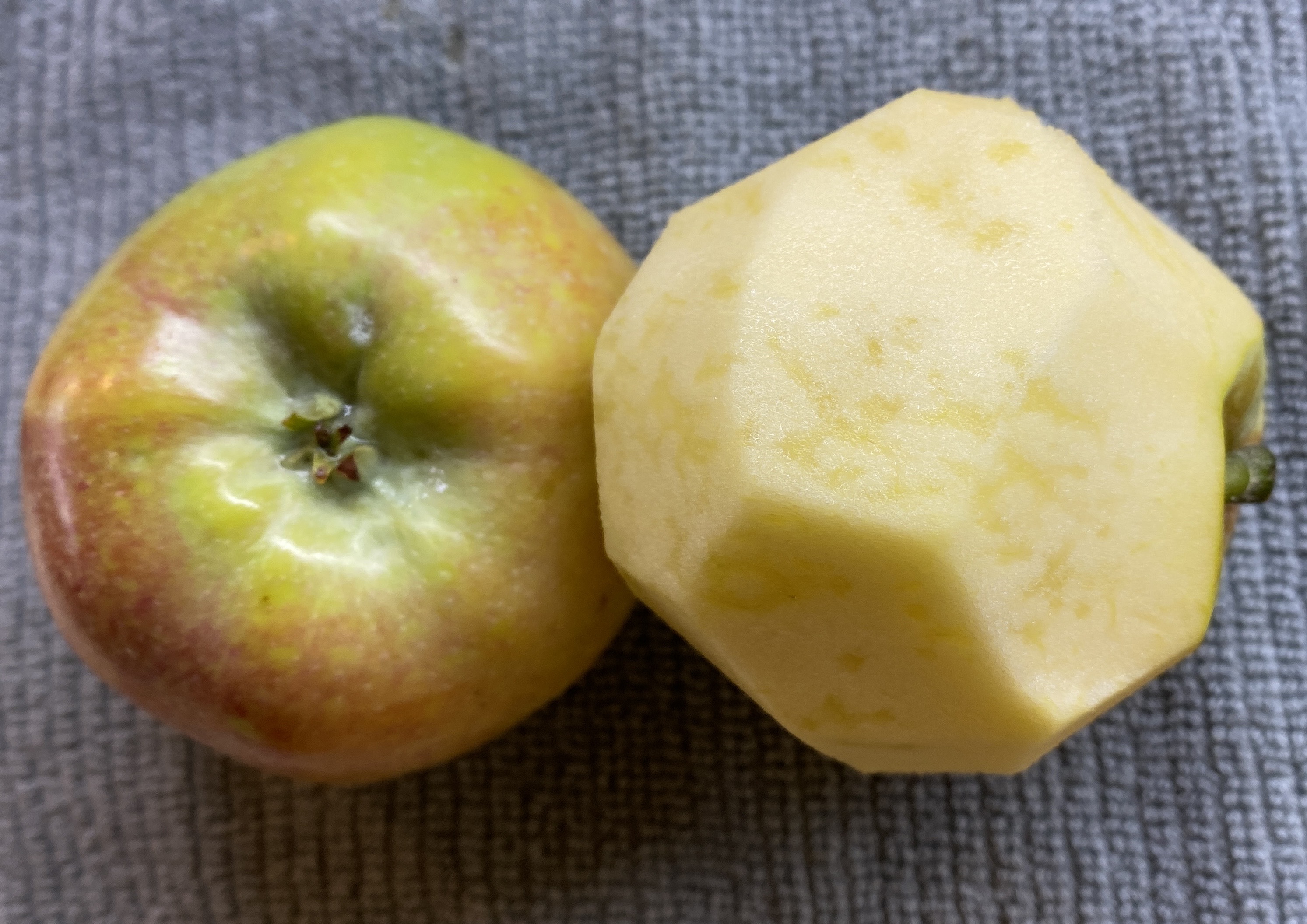

Pepin Shafranyi 


The flesh is denser than Gravenstein but juicy. Excellent balance of sweetness and acidity with some unusual flavors, maybe kiwi. Very enjoyable to eat. The flesh of some fruits gets the glassy patches, at least in my hot climate. I do not consider it as a defect for a summer apple.


Mislabeled 


I suspect this is Ginger Gold. Crunchy-soft-juicy flesh. Mostly sweet with a little acid. Very pleasant to eat. Seems to be sunburn resistant.


Check our sales site if we have the cuttings available reallygoodplants.com


Sunday, July 9, 2023

Early Apples in 2023

 This post describes three cultivars of early apples which fruited for me in late June - early July of 2023.

Pervenec Samarkanda (Первенец Самарканда)

The cultivar was introduced in 1959 by the Shreder (currently Miszayev) institute of pomology and viticulture in Samarkand, Uzbekistan. The USDA station in Geneva, NY grows this accession.  The name meaning (translated from Russian) is “Firstborn of Samarkand”. This probably refers to it being the earliest ripening apple. 

This accession fruited the first time this year for me, and turned out to be my best early apple of the season. The fruits are juicy, sweet-sour, very bright in the flavor and good in texture. They are medium-small in size, the skin is mostly light yellow, the flesh is white. This is considered to be the best apple for drying, and I understand why - the flavor will be even more concentrated in the dry fruit. I do not think this apple has any storage potential, and should be consumed in under a few weeks.


This apple deserves a better distribution especially in the hot climates. The fruits had none or minimal sunburn damage after the heatwave in June with the temperatures of over 110F. The tree canopy was very minimal and most fruits were exposed to sun.

Lowland Raspberry 

The accession is occasionally available as scions at the CRFG winter exchanges. This is a very old selection from the 19th century or even earlier. Originated in Lithuania and known back then in the Russian Empire as Malinovoye Lievlandskoe (Малиновое Лифляндское). I suspect that nowadays this cultivar in known in Russia as Ranet Letnii (Summer Ranet). There are no traces of Малиновое Лифляндское on the present Russian pages on the web. However, this cultivar is listed in the Botanical Glossary (in Old Russian) from 1878.


This is a sweet soft apple with low acidity. Good eating, pleasant and mellow in flavor. The fruits had some sunburn damage after the heatwave.

The fruits are yellow and striped with red, a bit wavy in the form. The flesh is white.

June Wealthy 

The scions of this accession came to me from the Perfect Circle farm in Vermont. These fruits were the largest, most attractive in the color, but also the most sour and sharp in the flavor. Most fruits were also badly damaged by the sunburn. Hopefully when the tree develops a larger canopy, the sunburn will not be as bad. This apple is for those who prefer sour apples.


Check our sales site if we have the cuttings available reallygoodplants.com


Wednesday, June 21, 2023

Pouteria species in the open ground in Davis, CA


 This post describes the Pouteria plants which survived multiple winters and summers in Davis, California.

My Montero Lucuma plant (Pouteria lucuma biotype Montero) was started from the seed of the tree growing at the San Diego botanical garden. Below are the pictures of the fruit from 2017.

The tree is over 8 ft now and I just noticed the first flower bud on it, the picture below.

The Montero biotype tree has short internodes with dark green leaves, the picture below.

My second Lucuma tree was started from a yellow type of Lucuma fruit in 2017 as well. This tree is now well over 10 feet and bloomed as least once already last year. I just found new flower buds on it, the picture is below.

The leaves on this tree are larger, medium green, and the internodes are longer, see the picture below.

I purchased my Canistel tree (Pouteria campechiana) as a small seedling from Ben’s Subtropicals during the Festival of Fruit in San Luis Obispo in 2016. This turned out to be the most vigorous Pouteria I have. The tree bloomed already for a number of years. Probably 10-11 feet tall now.


The fourth Pouteria I have in the ground is Cinnamon Apple, Pouteria hypoglauca. I purchased this tree in 2017 from the Roger Meyer estate. While this tree never bloomed yet, I’m still surprised that it can survive in my climate especially after the winter we just had in 2022-2023. Below is a picture of one of the branches ends. This tree is about 4 feet tall.


Tuesday, June 20, 2023

Harvey’s Early Yellow Peach

 A few years ago, my friend Harvey Correia discovered a large branch producing yearly peaches on his old peach tree. He purchased the tree over 25 years ago as Last Chance and recalls that he might have grafted it with Fairtime, both of which are late season peaches. The tree still produces at least one type of late peaches. I need to go back later in the season and taste those. He suspects that this branch with early yellow peaches that ripen in early June might be coming from the rootstock or could be a sport of the grafted variety. Unless we find out that this is known cultivar, we are going to call this branch Harvey’s Early Yellow peach.

The fruits are slightly flattened, medium in size, red and spotted. The flesh is yellow, melting, partially or almost freestone. The flavor is excellent with high sugar and high acid. I tend to think that it’s a Lovell seedling (the rootstock shoot). The Lovell fruits I had before were somewhat similar in the flavor, but those were ripening later in the season.


Monday, April 10, 2023

Public gardens around Sacramento and the San Francisco Bay Area


Sacramento State University Arboretum 


UC Davis Arboretum 


Sonoma Botanical Garden in Glen Ellen 


UC Botanical Garden in Berkeley 


Tilden Regional Park Botanic Garden in Berkeley 


Ruth Bancroft Garden in Walnut Creek 


Rare Fruit Tree Grove at the Quarry Lake Regional Recreational Area in Fremont 

California Nursery Historical Park in Fremont 


Shinn Historical Park and Arboretum in Fremont 


San Francisco Botanical Garden


Emma Prusch Farm Park in San Jose 

Hakone Estate and Gardens - Japanese Gardens in Saratoga


Filoli Historic House and Garden in Woodside


UC Santa Cruz Arboretum and Botanic Garden


Gilroy Gardens Family Theme Park hosts Bonfante trees


Sunday, March 19, 2023

Pollen granules of yangmei, Myrica rubra


I took the above pictures of the pollen granules on March 19, 2023. These were from the Adam selection of yangmei ( Myrica rubra ).

Saturday, March 4, 2023

Cuttings sale in March 2023

 The post describes the spring sale of wood on the Really Good Plants site.

The following accessions will be available for purchase on March 5 at 5 pm PT at reallygoodplants.com

The number after each cultivar states the initial inventory.

The sale will conclude on Saturday March 11 at 5 pm.

Avocado

Aravaipa 15

Sir Prize 10

Royal-Wright 25

Surinam Cherry 

Guaruja Red 20

the scions are pencil thick or thicker.  Please specify if you need the thinner ones.


Feijoa

Candy 14

Lickver’s Pride 12

Chesterwoody 16

Den’s Choice 16

White Goose 10

Marion 13

Albert’s supreme 11


Cherimoya 

Fortuna 10


Mulberry (some buds are getting green)

Galicia 8

Shelli 10

Isfahan 10


White Sapote

Golden Globe 14

Santa Cruz 7

Malibu #3 7

Rainbow 11

Malibu #1 10

Delta Gold 15

Michelle 6

Lemon Gold 15

Cuccio 9

Leroy 9

Roberts Rainbow 19


Yangmei 

Female Eve 20

Male Adam 10

BRIX and pH Values for Various Yangmei Cultivars

  I measured the BRIX and pH values for 9 different selection of yangmei on June 15, and for 5 selections on June 24. Whenever possible, 3 f...